To the magnificent structure we see today...
Cape Hatteras is the first Lighthouse to have been built in North Carolina. It was built in 1802, and lit in 1803. Originally it stood 90 feet tall, until it underwent modifications and additions that made it 150 feet tall. These modifications started in 1845, and ended in 1854. However, new problems arose. The tower had been built on a sand dune that was being eroded by the ocean. Also, the structure was badly damaged during the Civil War. The Lighthouse Board then decided that it would be cheaper to build a new lighthouse, than to repair the old one. So, in 1870, a new Cape Hatteras was designed and constructed: the new lighthouse stood at 198 feet tall, with an improved beacon system using a Fresnel lens (magnifies and intensifies the light from a small oil wick flame). Also, this new structure was built 600 feet north of the original structure, hoping to put some distance between it and the sea to prevent erosion. Once the new Cape Hatteras was completed and fully operational, the old one was destroyed, as it was already falling apart and continuing to erode into the sea.

After the new structure was built in 1870, it still continued to face problems with erosion, and now corrosion of the base from the salt water. For a time between 1936 to 1950, Cape Hatteras Lighthouse was closed to the public, due to danger from the erosion.
Saving the Lighthouse
Erosion slowly ate away at the land separating the lighthouse from the waves leaving about 150 feet of sand between the two. However, in the year of 1980, that distance was swiftly cut in half, due to two severe storms. The question arose: "Should we save the lighthouse again, or should we just let nature take it's course?" Despite tight budgets at both the national and state government levels, the decision was made to save it again. In October of 1981, the NC Democratic governor James Hunt, Jr. and the NC Republican U.S. Senator Jesse Helms, came together to co-chair a Save the Cape Hatteras Lighthouse Committee, which proposed to raise a million dollars to preserve the lighthouse. "Schoolchildren across the state raised over $20,000 to save the lighthouse" (Carr, pg 112). Initially, the idea to move the lighthouse was rejected, on the grounds that the estimated cost of the project (between $3 and $5 million dollars) was too low to be accurate. The plan then was to build an octagonal structure around the base (which is also an octagon) which would reach twenty-three feet above sea level, and another sixteen feet below sea level. The wall surrounding the base would have one-foot-thick walls, which would then be "reinforced by a twelve-foot-thick riprap of boulders and five-ton concrete pods reaching out like a talus slope fifty feet from the base" (Carr, pg 115-116). However, this seawall might eventually form a small island with the lighthouse at the center if water continued to rise. This plan was estimated to cost $5.5 million, with another $2 or $3 million later if they needed to completely surround the lighthouse (due to rising waters). The cost of this plan was problematic in that the $1 million dollar goal set by the Save the Cape Hatteras Lighthouse was not nearly sufficient for this plan to go through.
While debates continued to find an adequate, long-term plan to save the lighthouse, the National Park Service continued to take temporary measures to preserve the land in front of the lighthouse, such as Seascape. Seascape is an artificial seaweed designed by William L. Garrett of Delaware, who had used his device to restore sandy reefs at several other beaches. In the end (whether due to his innovation or natural forces), the beach in front of Cape Hatteras Lighthouse had expanded, and the Save the Cape Hatteras Lighthouse Committee decided to invest $165,000 in additional Seascape. By this time, $300,000 had been raised by the group, which went to help National Park Service preserve the lighthouse until federal funds were available for a long-term solution.
During the year of 1983, while plans were being tested for the seawall, Orrin Pilkey and David Fischetti discussed how, although the seawall would protect the lighthouse from erosion, it would not protect it from damaging winds and storm tides due to powerful hurricanes. They rallied to persuade the National Park Service to reconsider relocation, as the best option for saving the lighthouse. Finally, in December of 1989, the National Park Service was convinced that moving the lighthouse was the best way to save it.
Moving the Lighthouse
Cape Hatteras weighs 4,400 TONS, and is approximately 200 feet tall. This was NOT an easy move. The International Chimney Corporation of Buffalo, New York, won the contract to move Cape Hatteras in 1999. Simply, the move consisted of lifting it off its foundation, transferring the load to a transport system (comprised of hydraulic jacks on rollers), moving the tower along a prepared move route of steel beams, and installing it on a new foundation. After removing the original foundation, one hundred hydraulics, each with a one-hundred-ton capacity, were put in place to lift the lighthouse. As the lighthouse was lifted ten inches at a time, new oak timbers and metal beams were inserted to hold the now separated tower in place until the jacks could be reset for another thrust. When it was raised about eight feet in the air, a rolling carriage system was installed beneath it.
In the early afternoon of June 17, 1999, Cape Hatteras Lighthouse started its' trek across the dunes. By the end of the first day (just a few hours), the tower had been moved only about ten feet. After a few weeks, progress had increased to an average of 125 feet per day. Numerous sensors were placed both inside and outside the lighthouse, measuring stress, temperature, vibration, and tilt.
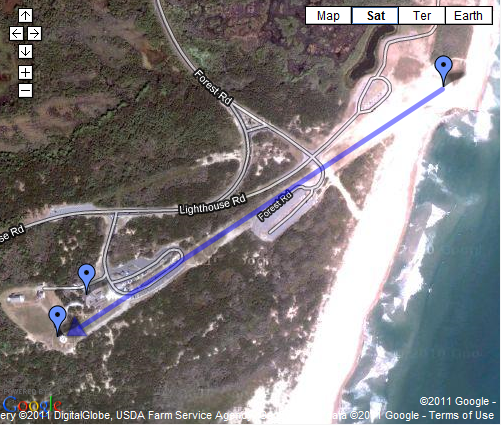
Originally, the trip was estimated to take six weeks to travel 2,900 feet across the dunes. However, on July 9, 1999, the lighthouse reached the blue strip of tape marking its' new location--in just three weeks. The lighthouse was placed on the sixty-foot-square concrete pad, with a new four-foot-thick foundation that will hopefully hold for another 130 years.
After the tower was carefully checked for any damage done during the move, Cape Hatteras Lighthouse was reopened to the public in May of 2000.


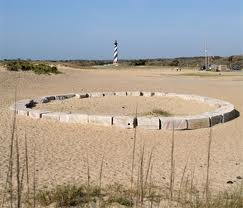
Cape Hatteras is the first Lighthouse to have been built in North Carolina. It was built in 1802, and lit in 1803. Originally it stood 90 feet tall, until it underwent modifications and additions that made it 150 feet tall. These modifications started in 1845, and ended in 1854. However, new problems arose. The tower had been built on a sand dune that was being eroded by the ocean. Also, the structure was badly damaged during the Civil War. The Lighthouse Board then decided that it would be cheaper to build a new lighthouse, than to repair the old one. So, in 1870, a new Cape Hatteras was designed and constructed: the new lighthouse stood at 198 feet tall, with an improved beacon system using a Fresnel lens (magnifies and intensifies the light from a small oil wick flame). Also, this new structure was built 600 feet north of the original structure, hoping to put some distance between it and the sea to prevent erosion. Once the new Cape Hatteras was completed and fully operational, the old one was destroyed, as it was already falling apart and continuing to erode into the sea.
After the new structure was built in 1870, it still continued to face problems with erosion, and now corrosion of the base from the salt water. For a time between 1936 to 1950, Cape Hatteras Lighthouse was closed to the public, due to danger from the erosion.
Saving the Lighthouse
Erosion slowly ate away at the land separating the lighthouse from the waves leaving about 150 feet of sand between the two. However, in the year of 1980, that distance was swiftly cut in half, due to two severe storms. The question arose: "Should we save the lighthouse again, or should we just let nature take it's course?" Despite tight budgets at both the national and state government levels, the decision was made to save it again. In October of 1981, the NC Democratic governor James Hunt, Jr. and the NC Republican U.S. Senator Jesse Helms, came together to co-chair a Save the Cape Hatteras Lighthouse Committee, which proposed to raise a million dollars to preserve the lighthouse. "Schoolchildren across the state raised over $20,000 to save the lighthouse" (Carr, pg 112). Initially, the idea to move the lighthouse was rejected, on the grounds that the estimated cost of the project (between $3 and $5 million dollars) was too low to be accurate. The plan then was to build an octagonal structure around the base (which is also an octagon) which would reach twenty-three feet above sea level, and another sixteen feet below sea level. The wall surrounding the base would have one-foot-thick walls, which would then be "reinforced by a twelve-foot-thick riprap of boulders and five-ton concrete pods reaching out like a talus slope fifty feet from the base" (Carr, pg 115-116). However, this seawall might eventually form a small island with the lighthouse at the center if water continued to rise. This plan was estimated to cost $5.5 million, with another $2 or $3 million later if they needed to completely surround the lighthouse (due to rising waters). The cost of this plan was problematic in that the $1 million dollar goal set by the Save the Cape Hatteras Lighthouse was not nearly sufficient for this plan to go through.
While debates continued to find an adequate, long-term plan to save the lighthouse, the National Park Service continued to take temporary measures to preserve the land in front of the lighthouse, such as Seascape. Seascape is an artificial seaweed designed by William L. Garrett of Delaware, who had used his device to restore sandy reefs at several other beaches. In the end (whether due to his innovation or natural forces), the beach in front of Cape Hatteras Lighthouse had expanded, and the Save the Cape Hatteras Lighthouse Committee decided to invest $165,000 in additional Seascape. By this time, $300,000 had been raised by the group, which went to help National Park Service preserve the lighthouse until federal funds were available for a long-term solution.
During the year of 1983, while plans were being tested for the seawall, Orrin Pilkey and David Fischetti discussed how, although the seawall would protect the lighthouse from erosion, it would not protect it from damaging winds and storm tides due to powerful hurricanes. They rallied to persuade the National Park Service to reconsider relocation, as the best option for saving the lighthouse. Finally, in December of 1989, the National Park Service was convinced that moving the lighthouse was the best way to save it.
Moving the Lighthouse
Cape Hatteras weighs 4,400 TONS, and is approximately 200 feet tall. This was NOT an easy move. The International Chimney Corporation of Buffalo, New York, won the contract to move Cape Hatteras in 1999. Simply, the move consisted of lifting it off its foundation, transferring the load to a transport system (comprised of hydraulic jacks on rollers), moving the tower along a prepared move route of steel beams, and installing it on a new foundation. After removing the original foundation, one hundred hydraulics, each with a one-hundred-ton capacity, were put in place to lift the lighthouse. As the lighthouse was lifted ten inches at a time, new oak timbers and metal beams were inserted to hold the now separated tower in place until the jacks could be reset for another thrust. When it was raised about eight feet in the air, a rolling carriage system was installed beneath it.
In the early afternoon of June 17, 1999, Cape Hatteras Lighthouse started its' trek across the dunes. By the end of the first day (just a few hours), the tower had been moved only about ten feet. After a few weeks, progress had increased to an average of 125 feet per day. Numerous sensors were placed both inside and outside the lighthouse, measuring stress, temperature, vibration, and tilt.
Originally, the trip was estimated to take six weeks to travel 2,900 feet across the dunes. However, on July 9, 1999, the lighthouse reached the blue strip of tape marking its' new location--in just three weeks. The lighthouse was placed on the sixty-foot-square concrete pad, with a new four-foot-thick foundation that will hopefully hold for another 130 years.
After the tower was carefully checked for any damage done during the move, Cape Hatteras Lighthouse was reopened to the public in May of 2000.

